Enough said...
Friday, February 22, 2008
Photo Hunt - Theme 'Free'
Enough said...
Thursday, February 14, 2008
Photo Hunt - Theme 'Heavy'
Wednesday, January 30, 2008
Photo Hunt - Theme 'Old Fashioned'
Anyway, back to this week's theme of 'Old Fashioned'. The one thing that I keep telling my friends & colleagues from abroad who want to know about India is "Never Generalize". India to me is a country of contrasts. Culture, language, dress, food, ideas, beliefs, religion, economic well-being - you name it. Also at the heart of this study of contrasts is the conflict of the old and the new. An example of this is the shot below - this is a National Highway, where you will get to see trucks and the latest cars blazing the trail. What you also have is this - an elephant on the road! So while the well-off zip by in their swanky cars, for some people life goes on as it did perhaps hundred years ago.
If you are not from India, remember not to judge 'Incredible India' by one story or one shot. The understanding of the sheer diversity of the country is at the heart of visiting and enjoying it.
Friday, October 26, 2007
Luna-tic
Somehow any mention of the moon gets instantly associated in my mind to Pink Floyd's Dark Side of the Moon. Seeing yesterday's bright moon, I could not but help wondering what it must be on the 'other' side :-)
The lunatic is in my head
You raise the blade, you make the change
You re-arrange me till I'm sane
You lock the door
And throw away the key
There's someone in my head but its not me.
And if the cloud bursts, thunder in your ear
You shout and no one seems to hear
And if the band you're in starts playing different tunes
I'll see you on the dark side of the moon"
Brain Damage by Pink Floyd. Album: Dark Side of the Moon
Labels: Dark Side of the Moon, full moon, India, Kolkata, Lakshmi Pujo, Pink Floyd, Random Thoughts
Monday, October 22, 2007
Puja 2007
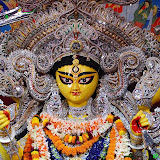
Durga Puja is the biggest festival in Bengal. Its significance is not restricted to the religious aspect only. It is a celebration for the senses and the emotions. For four days the city of Kolkata is lit up with brilliant lights. Puja pandals (temporary structures where the worship takes place) sprout up all over the city - some done to a particular 'theme' and more modern, others retaining years old traditions and artistic styles. People descend on the streets all day and all night long dressed in new clothes. Puja also means a gastronomic extravaganza with everybody from the street food vendor to the 5 star restaurateur doing brisk business all day long.
Puja also means coming together of friends and families. Bengalis all over the world, wherever they are, wish to come back to their homes at this time. The lucky ones who make it feel special, the ones who don't - well, lets not dwell on their agony.
Then this Sunday, it has all ended with Bijoya Dashami. The festivities are now over, my friends have gone back to the cities they work and it is back to mundane life. That's how it is every year - 4 days passing like a heady dream and then ending leaving one heavy hearted. But there is also hope for the future - idols (Bengali: 'protima's) are submerged in the Ganges amidst chants of 'Aashchey Bachor Abaar Hobey' (rough translation: 'Till we celebrate again next year')
Wednesday, August 29, 2007
State of the Nation
At the outset, let me confess that I think that overall we have achieved very little to be proud of since Independence. It makes me sad to even write this sentence, but that is how I feel honestly.
First of all, the entire political system is in shambles. Politics may be 'the last refuge of a scoundrel', but politicians are important nevertheless because it is they who decide the country's fate. That's where I feel India's democracy has failed. Inspite of the recent electoral reforms, the politicians that finally get chosen have no merit. Elections are won on money & muscle power.
Politicians are like mutating viruses that ail our country. In early years of the nation, they trumpeted the ideology of socialism. The result - suppresion of the free spirit of enterprise, license raj and creation of behemoth puclic sector units (who bleed the nation more than they contribute to it). But at least the politicians in those days had some conscience, some credibility. Today's politicians have criminal history, more often than not. Political parties place their own agenda and the security of their vote bank ahead of the country's interest. An example - the same political party touting the virtues of industrialization in one state and condemning the same in another state. One has to use a microscope if one has to find any semblance of values/honesty/ideology in today's politics. Perhaps come up short, even with a microscope.
This being the root cause in my opinion, let me highlight some of it's effects -
>>> The Green Revolution is often used as an example of our achievement & progress. But inspite of the self-reliance it has given us, many many people in India still go hungry each day. An estimated 40% of all Indian children are malnourished. To top it all, some people still die simply of hunger each year.
>>> The health & social security system is virtually non existent. There may be some private health institutions that may be better off, but virtually nothing has been done for public health. Far from providing quality healthcare, government hospitals are hell-holes full of corruption, squalor & filth. Doctors battle against all odds to provide assistance to patients. An estimated 5 million in India already suffer from AIDS and the country is expected to have the largest AIDS population by 2020.
>>> We have scant regard for history & the sacrifice common people for the country. In my opinion, no country can be great without having respect for its past. Historical monuments suffer from lack of funds & maintenance. Soldiers who gave up their lives for the country are allotted paltry pensions - even which their families have extreme difficulty in obtaining.
>>> Lawlessness is the rule of the land (This incident from yesterday, is a case in point). In many parts of the country, it is the gun that rules. The tiny majority in the police that are willing to work are handicapped by lack of funds, archaic laws and more often than not, political interference. The rest of the police system is of course corrupt to the core and perpetrators of violence themselves.
>>> Socially too, we have gone backwards rather than forwards. Evils like dowry, killing girl childs, casteism etc still exist - shockingly even among the well educated. The political system of course adds to this by creating divides in the name of reservation and such like. If the idea was to shield the weak from the privileged, why not base the quotas on family income level? Primarily because that would not helped anyone's votebanks. So - be it in education, sports or jobs - it is not merit but caste that draws the lines. Appeasement is the mantra & it is mediocracy that thrives.
>>> Roads, infrastructure & general services are an area where the country has failed terribly. Contractors make roads that crumble in a few days so that they get a second contract. Cows roam the roads. Illegal shops & hawkers block pavements & roads blatantly. The only traffic rule is that there are no rules. And none of this is likely to change because the law makers & enforcers are scared to hurt anyone's sensibilities.
>>> It is said that the state of sports reflects the health of the country. The statement could not have been more relevant anywhere else other than India. In all sports, the governing bodies are run like personal fiefdoms by politicians. Cricket of course, has spurned money - but only for the BCCI and select few cricketers. It is shameful to see reports of the condition of former players. They remain neglected and struggling to make ends meet. In all sports, apart from few instances of individual brilliance, we have languished at the bottom. To us, participating is defnitely more important than winning.
>>> Our frustration with a corrupt system has in turn made each one of us corrupt. We take the law into our own hands without a qualm. We give & take bribes with impunity, we have lynchings in full public view. Parents spend money on unfair means to get their child into a coveted institutions. "Political demonstrators" come out on the streets at every opportunity - organize 'bandhs', ransack shops (in the name of stopping 'blood-thirsty' industrialists) and paralyze life.
The most unfortunate bit is the mindset that we, as Indians, have got into. In spite of the explosion of media in recent days - a vast majority of us remain ignorant about our rights, issues and in general remain impervious to what's going on around us.
Even when we, the educated few, come across an issue - we choose to turn a blind eye (myself very much included). We follow Kargil on TV with zeal, out blood boils with patriotic fervour when we see a 'Chak De India' or 'Rang De Basanti'. But none of us actually do anything of significance about these evils that ail our country. Unfortunately, the few who do - land up dead.
All in all, India maybe shining in the eyes of some in insulated environs of multiplexes, glitzy shopping malls & IT companies. But day by day, slowly but steadily, we are on the steadfast road to being a failed country & a banana republic.
Friday, July 14, 2006
The recent Mumbai bomb blast - some thoughts...
7/11 - Mumbai was ripped apart by 8 bomb blasts - around 200 people killed, hundreds more are gravely injured. The many 24x7 news channels across Indian TV space scramble over each other to provide the details - live feeds, audience reactions, expert panel interviews...
7/12 - Mumbai is trying to slowly crawl back to normal, people are going back to work...TV channels such as CNN-IBN go gaa-gaa about the "Mumbai spirit".... images are being shown of people helping each other on the streets, water & food being provided to the stranded, people are queuing up in front of blood banks...
People going back to work the very next day after the blast are interviewed, especially those who are traveling by the local train network...Mumbai is returning to "normal"...
7/13 - The security agencies and police are woken up from their slumber and they pretend to be doing their work - more than 350 have been detained...LeT & SIMI are being suspected as the perpetrators.
7/14 (today) - The bomb blast news is no longer the sole story hogging the headlines - the 'breaking story' is now just another story....
Tomorrow - Mumbai returns to "normalcy", the bomb blast story vanishes from the headlines and most importantly - we forget...
A regular and familiar pattern - all of us are proud and resilient Indians - we can take pain (give us more, please)...we are famous for our ability to "bounce back"....
Question is, do we really "bounce back"? Are the people who are traveling by Mumbai local trains today doing so because they want to show bounce back or prove to somebody that "
For the people who HAVE been the real victims, people who have lost their family, their friends...people who lost their limbs and will never lead an active life again....will things ever return to "normal" again? In my opinion, no...
There will be some arrests surely (maybe after 10/15 years), a high profile trial - and then mostly likely an acquittal. The accused will then proclaim himself as the "victim of the media's witchhunts" and win an election on a sympathy wave..
Okay, maybe I have gone too far in the last bit - but the reality is nothing will never happen, nothing will change. The whole nation will seat glued to TV watching the "breaking news", there will be reams of newsprint printed, parliament will see heated discussions, people will chat, rave, rant, blog (like me here!), and then we will forget - and then the cycle will start again for yet another story.
This brings me to a question which is related to what I have already said above - I have never understood why our collective public memory is so short? Why do we forget so quickly? Why is it that any issue which is burning today is not even in the fine print tomorrow?
There are so many examples in the recent past - the reservations issue for example. Protests, hungerstrikes, resignations and even self-immolations. Ultimately all that has changed nothing! And then quietly, slowly but surely that issue has vanished from each our minds.
Even non-issues such as during the release of Da Vinci Code will stir the Indian media into frenzied activity. Issues such as these have shorter lifetimes but during that time they even have the capacity of displacing the more important issues from the limelight.
Another area which gives (or used to give, in my case) us national identity is cricket. There also, for example a cricketer turns in a great performance in a match. He is hailed by all and sundry as the next Sachin Tendulkar or the next Kapil Dev. The whole nation will idolise him, people will sport his hairstyle - and then he flops in the next match. Lo and behold - all that was said & sung before is conveniently forgotten. That very same player will then be the villain and will be put down to the dust...
Or take for example the scant regard with which we treat our own history and our own monuments. How many times have we seen people deface our monuments by scribing their names on them? Or for that matter monuments covered in 'paan' stains and garbage?
All of this is something which arouses great curiosity in me. What is it that has caused our public memory to be so short? Why do we forget (and perhaps forgive) the past so quickly? Is it the role played by the media? Or is it the fact that given our continuous struggles with the present we can afford no time for the past?
I wonder....can someone answer?
Labels: bomb blast, India, media, Mumbai