Saturday, February 02, 2008

Oh Calcutta! Part One

Ever since I first started my blog, I had been thinking of featuring the city in which I was born and where I have spent all my life (well almost, but for a year or two here & there!). Its better late than never and from time to time I will try to present different facets of my beloved city in this blog.

Calcutta (or Kolkata as it is called now) is rather difficult to summarize, or introduce in a few sentences. In terms of age, Kolkata is rather young (believed to have been founded in 1690) as compared to Delhi or Beneras (Varanasi). Despite its short history, it was the capital of British India till 1911. During that time the city was at the forefront of a mini-Renaissance and produced some of India's greatest thinkers, social reformers, politicians, poets and scientists in the nineteenth & twentieth centuries. On the other hand, post India's independence in 1947 and especially post the politically turbulent period in the 1970's, Kolkata slumped into what some called (rightly, or perhaps a wee bit too harshly) a 'dying city'. It's fortunes have since looked up and it has regained some of the earlier economic & social dynamism.

The short, yet eventful, history of Kolkata has had a deep impact on the basic fabric of the city. I will be touching upon the various facets of Kolkata's life & culture in the forthcoming posts. For now, I wish to touch upon currently the only visible aspect of the British 'Raj' in Kolkata - that is the architecture. Many monuments and important buildings in Kolkata are a remnant of the 'Raj' and examples of typical nineteenth century colonial architecture.

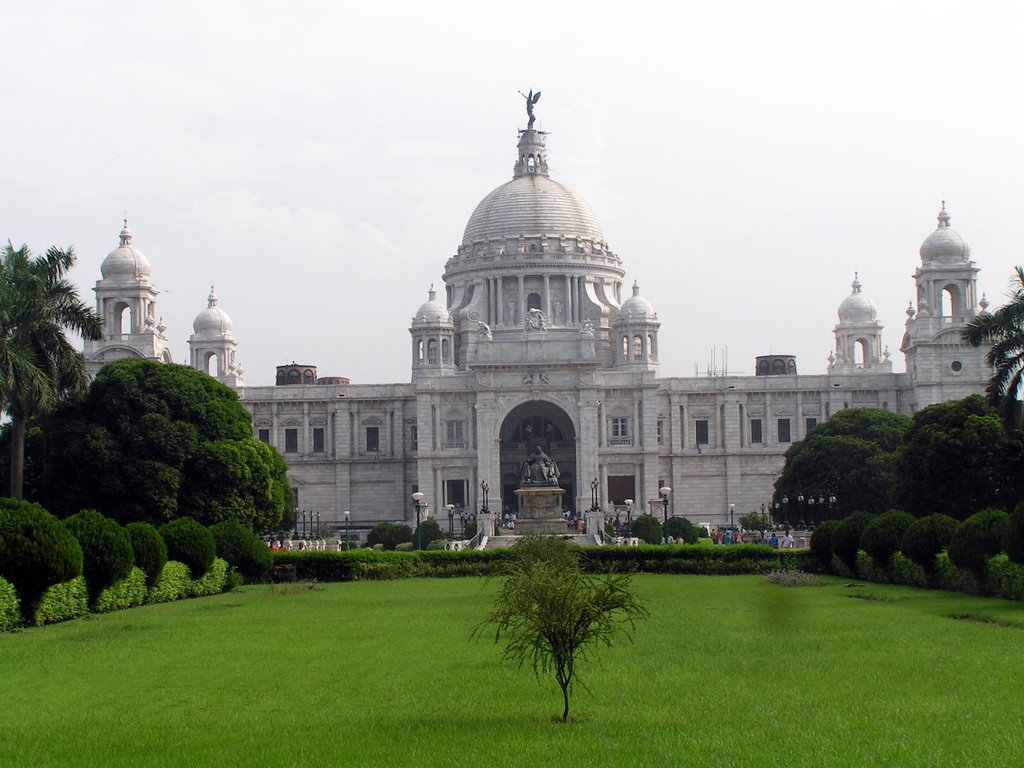
The Victoria Memorial was built by the British as a tribute to Queen Victoria. The white marble palace stands now as perhaps the most famous landmark in Kolkata's skyline. It now houses an musuem where many valuable artefacts of British India are on display. The Victoria Memorial is an even more dramatic & enchanting sight in the evening when it is brilliantly lit up.

The Howrah Bridge spans the Hoogly river and connects Kolkata to it's most important railhead at Howrah. Thousands of people use it every day, both on wheels and on foot. Due to its age (it was built way back in 1943), movement of trucks and other heavy vehicles have been restricted. Apart from being a vital artery of the city's traffic movement, the bridge is also an engineering marvel. It is a cantilever bridge held together by rivets and bolts.

More on other facets of Kolkata in coming posts..


Tuesday, November 20, 2007

A Change of Seasons


This year we have seen a rather early arrival of winter in Kolkata. The days have become pleasant and there is a slight chill at night. Last year (in 2006), I was in Eagan, Minnesota (US) during winter. That was the most bitter winter that I had ever experienced with very heavy snowfall and more disconcertingly, the howling & bone-piercing winds.

The two winters before that (in 2004 & 2005) I was in Copenhagen, Denmark. Though it snowed regularly, the winters there were less extreme. The days were really short though, with sunlight lasting for only about 6 to 8 hours in a day. Even while it lasted, most of the time it remained muggy and overcast. One of my favourite places in Copenhagen was very near to where I lived - the Frederiksberg Castle (Danish: 'Slot') and the surrounding gardens (Danish: 'Have'). Right below is a shot of the Frederiksberg Slot during the height of winter in Copenhagen (owing to the snow and the poor light the shot is not tack sharp, I must admit)

But in summer, it was a different story altogether. Danish summers are the best that I have ever experienced. The weather is extremely pleasant and not too hot. The skies are clear for days at a stretch. Also it seemed entire Denmark came out to party to make the most of the short summer. The change is pretty obvious if you now take a look at the photo below - it is the same place as the one above. In summer the skies are blue and the grass is green :-)


Friday, October 26, 2007

Luna-tic

Moon over Kolkata, India on 26th October, 2007
Nikon D40X with Nikon AF-S DX VR 55-200 mm lens on a tripod

Yesterday in India the moon was the brightest and the biggest of the year, in fact the biggest since December 1999. The moon was said to be 14 per cent bigger and 30 per cent brighter than the average full moon (source: The Telegraph, India). Yesterday was also the occasion of 'Kojagori Lakshmi Pujo' here in Bengal. Kalyan's blog here gives an excellent account of the occasion.

I had, in fact, hoped to capture a few more details of the moon's surface. But looks like I had either underestimated the distance between the earth & the moon, or had overestimated the power of my 55-200mm zoom! All in all, what you see above is what I got.

Somehow any mention of the moon gets instantly associated in my mind to Pink Floyd's Dark Side of the Moon. Seeing yesterday's bright moon, I could not but help wondering what it must be on the 'other' side :-)

"The lunatic is in my head
The lunatic is in my head
You raise the blade, you make the change
You re-arrange me till I'm sane
You lock the door
And throw away the key
There's someone in my head but its not me.

And if the cloud bursts, thunder in your ear
You shout and no one seems to hear
And if the band you're in starts playing different tunes
I'll see you on the dark side of the moon"

Brain Damage by Pink Floyd. Album: Dark Side of the Moon

Monday, October 22, 2007

Puja 2007

Another Puja has come and sadly, now gone. As it does every year, the four days of heady celebration (culminating on Sunday, 21st October) have left behind a terribly empty feeling, an equivalent of a withdrawal symptom.

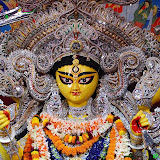
Durga Puja is the biggest festival in Bengal. Its significance is not restricted to the religious aspect only. It is a celebration for the senses and the emotions. For four days the city of Kolkata is lit up with brilliant lights. Puja pandals (temporary structures where the worship takes place) sprout up all over the city - some done to a particular 'theme' and more modern, others retaining years old traditions and artistic styles. People descend on the streets all day and all night long dressed in new clothes. Puja also means a gastronomic extravaganza with everybody from the street food vendor to the 5 star restaurateur doing brisk business all day long.

Puja also means coming together of friends and families. Bengalis all over the world, wherever they are, wish to come back to their homes at this time. The lucky ones who make it feel special, the ones who don't - well, lets not dwell on their agony.

Personally for me, this Puja went like a dream. Most of my closest friends from school-days were in Kolkata. We celebrated like we always do - with good food! The meal at Sanjeev Kapur's Ivory (formerly Grain of Salt) on Saptami night was especially memorable. We also went out to Waldorf's on Park Street for Chinese food and Orchid's (a favourite small place at Elgin Road) for momo's, among others. And then of course, close friends coming together means one very special thing for Bengali's - "adda" (a very rough equivalent of what others would call 'good conversation').

Then this Sunday, it has all ended with Bijoya Dashami. The festivities are now over, my friends have gone back to the cities they work and it is back to mundane life. That's how it is every year - 4 days passing like a heady dream and then ending leaving one heavy hearted. But there is also hope for the future - idols (Bengali: 'protima's) are submerged in the Ganges amidst chants of 'Aashchey Bachor Abaar Hobey' (rough translation: 'Till we celebrate again next year')

Puja 2007
Click on the photo above to open link to photo album


Wishing everyone Subho Bijoya - let the festive season bring you happiness and joy :-)

Tuesday, October 03, 2006

Pujo 2006

Last year was the first time I missed Pujo in Kolkata - away in Denmark, far from all the fun and festivities here.

This time, of course, I was in Kolkata and that made it all the more enjoyable. Also this time most of my school friends were able to make it back to Kolkata for the Pujas.

In fact the festivities for me started on Panchami itself with a lunch out to Charnock City - kebabs, tandoori pomphret, dub-chingri, chitol maach ..et al. The next day also we had a lunch out to Honey-da-dhaba - tandoori chicken being the highlight. And that evening I had the opportunity to say goodbye to office for 4 days...

The next 4 days were extremely enjoyable and relaxing, punctuated by several binge sessions at Marco Polo in China, Flavours of China, Cafe The Atrium at the Park Hotel and also excellent home made food.

On Saptami we went to Doshghhora (Abodesh's ancestral home). Here are a few photos from that day - http://picasaweb.google.com/aniyogi/Pujo2006290906Doshghhora

These are a few snaps from Ashtami morning - a day when tradionally most Bengali's go their local pandals to offer 'anjali'... http://picasaweb.google.com/aniyogi/Pujo2006300906Ashtami

We also hired a Sumo and went on a night long pandal hopping trip on Nabami night -
http://picasaweb.google.com/aniyogi/Pujo2006011006Nabami

And this is a video I shot on Ashtami morning (Warning: those of you who missed the Puja's are gauranteed to feel extremely nostalgic and heavy hearted!)....
http://video.google.com/videoplay?docid=5696580019408203696

Shubho Bijoya !!

Thursday, August 24, 2006

100 years old and soon a memory?

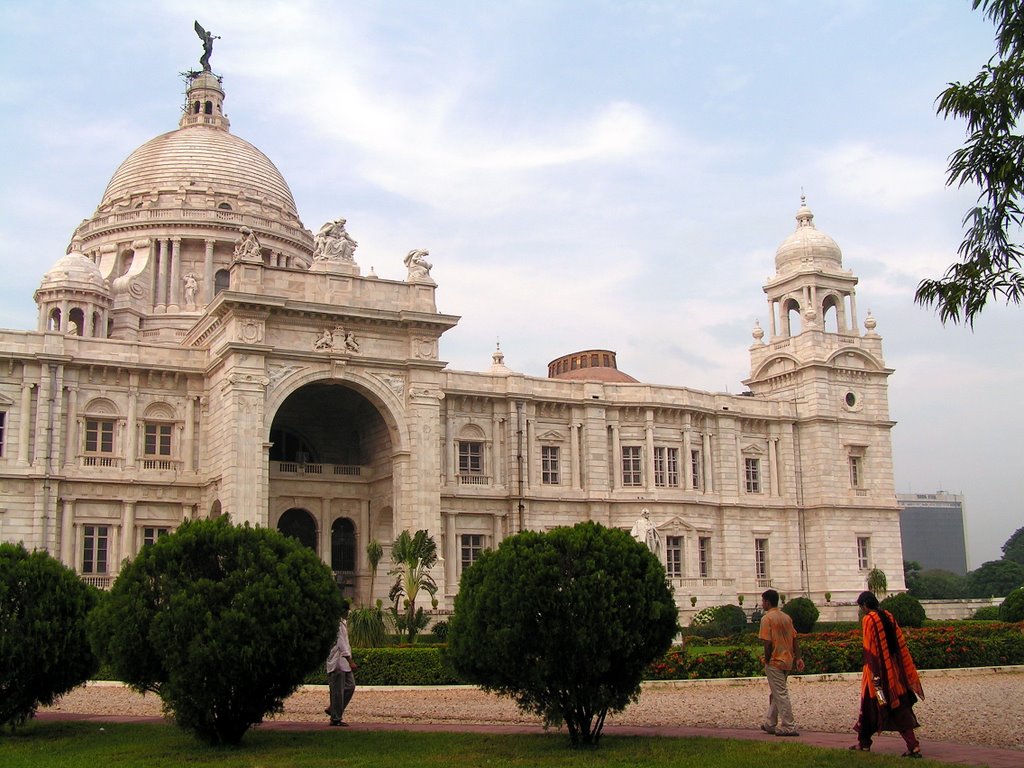
Recently after a long time (possibly the first time since my childhood) I went to Victoria Memorial Hall in Kolkata. Some photos from the visit and some thoughts follow -


This building which was built as a symbol of the domination of the British Raj, is celebrating its 100 years this year. Though without a doubt better off when compared to many other historical monuments in India, this Kolkata landmark has been suffering badly in the hands of time & neglect.

For example, the dome itself is leaking. This is apparent as soon as we climbed up the steps and reached the front door. It was raining and some buckets had been strategically put in place to hold the water falling from the roof. The seeping roof has long been a cause of concern and there has been some talk of taking some temporary steps as well as some more long term actions. Going by the evidence I saw, not much headway has been made.

The inside was no better. Only about a third of the whole musuem is air conditioned. Priceless paintings and other artifacts therefore lie exposed at the mercy of Kolkata's hot & humid weather.

The 5 m tall bronze statue of the 'Angel of Victory' (as can be seen in the photo above, atop the dome) has always been in news since 1999, when it stopped rotating. After numerous petitions and court litigations finally something happened when experts from Jadavpur University were called in. They diagnosed the problem to be - "The problem with the Angel was mainly because of two things. One was the copper conductor which was placed to bypass the lightening current was taken out. As a result, the lightening current, which has passed through the bearings, got spot wielded. So, the whole thing became one piece. The other one was that the space in between the bearing, space between the spindle and all these were packed up with mixture of marble dust, white cement and iron powder".

Work is currently underway to fix these problems. But there has been an allegation that clearing the cementing material at the base of the angel has caused seepage of water into the hall from the roof. We can only hope that all the concerned authorities get their act quickly and give this building it's due importance in it's 100th year.


Tuesday, July 25, 2006

'Tiffin' @ Work

A recent article from BBC News - Mumbai's "dabbawallas" have now gone online. The incredible chain of lunchbox pickup from homes and the delivering it on time at far away workplaces at lunchtime has long been showcased as an example of efficiency, dedication and teamwork. In fact, the study of the Dabbawallah's has made it to the course curricullam of several of India's B' schools as an example of supply chain management efficiency.

This brings to my mind the entire scenario of having 'tiffin' or lunch at our offices. To think of it, this need has lead to a whole sub-economy in India. I do not have the experience of working in any other city in India other than Kolkata - so my experience is restricted to Kolkata itself and that is what I will write about here.

Now we all know almost any Bengali can is invariably a 'bhojon-roshik' (rough translation: food afficianado). We Bengali's sure do enjoy and know our food. And since more than half the time in a typical day is spent at office, office 'tiffin' or lunch becomes a life saving necessity...

Before the fast food and eating out revolution hit us, most people used to carry lunch from home (many people still do now, but I believe the percentage has gone down). Now of course, there are various options available - be it the office canteen, street food, restaurant take-aways and such alike.

Office canteens are for the more conservative at heart - they dish out the regular Bengali 'thaali' or multi-course meals. Typical meal would consist of a rice and/or roti, some vegetables (in most days heavily dominated by the cheapest vegetable available - potato), fish or chicken curry and a 'mishti' (Bengali sweets) or doi (yoghurt - made the Bengali way).

Now many people are constantly driven by the spirit of adventure and innovation - and the above staple fare served at office canteens will not satiate their taste buds. That is where the street food of Kolkata comes into the picture.

The two places in Kolkata who have earned their fame in this regard are Decars Lane and Camac Street, especially the former. In both these places you would find an amazing variety of food available - bengali, north indian, south indian, "chinese" (thoroughly Indianised) and also what is proclaimed as 'Continental' (stews and such alike). The requirements from most people eating in these shops are primarily how filling the food is (the quantity), how cheap the food is and also how quick the 'service' is. The though of pristine hygiene is something which one will have to forego if eating at these places.

Another late entrant to the Kolkata lunch scene is the 'dabba' - now 'dabba' in Kolkata is not what is meant by 'dabba' in Mumbai. In Mumbai the 'dabba's contain food is home-made and is then to an individual at his work place. In Kolkata the 'dabbawala' delivers food which he has made/procured himself.

In this regard I should mention the lunch scenario in the IT industry belt of Kolkata (primarily Sector V, Salt Lake). Here the situation is a different because there are very few restaurants in this area. Most people either bring food from home or have it in their respective office canteens. But there are two more options - firstly there are some vendors who bring in food in mobile vans. They come in at lunchtime - serve the food out of the car/van and then leave. There are also a number of semi-permanent structures - they are referred to as 'jhhupri' in Bengali ('jhhups' is a recent trendy name :-)). These 'jhhups' normally have steaming hot rice, 'daal' & fried fish on the 'menu' - the hygiene bit of course leaves a lot to be desired.

Wednesday, April 05, 2006

Food delights found only in Kolkata

Got this list from a friend by mail recently. Would like to thank the kind-hearted soul who took the effort in compiling this. The delight he got from compiling it is pretty evident in hs language :-)

Unfortunately, only people who have lived in Calcutta will realise what these mean or what they taste like. But those for those of us who have - it will help to revive memories and urge us to try them out once again...and again..and again...

These are culinary gems available in only Kolkata!

  • Kabiraji Cutlet from Regent (S N Banerjee Road)
  • Moghlai Parota from Anadi Cabin (S N Banerjee Road)
  • Kosha Mangsho from Golbari (Shyambazar)
  • Phulkopir Singara from Mrityunjoy (Lansdowne)
  • Double Egg Chicken Roll from Kusum / Park Steet)(Campari @ Gariahat & Nizam is a close contender!)
  • Chicken Rezala from Shabbir (off C R Avenue)
  • Steak at Oly pub (with beer!!)
  • Ujjala's Chanachur ( no comparison anywhere)
  • Telebhaja from Putiram (College Street)
  • Daab Chigri from Kewpies (Elgin Lane)
  • Chicken Cutlet from Baked & Fried (Ballygunge Place)
  • Bijoli Grill's Fish Roll
  • Mochar Chop Dhoka from Apanjan (Sadananda Road)
  • Boudir's Lebu Cha (Deshapriya Park)
  • Kochuri & Tarkari from Tasty Corner (Mandeville Gardens)
  • Phuchka/Churmur/ Dahi Phuchka from Bilas or Boudi (Southern Avenue)
  • Chicken Cutlet near Samur (Bhowanipur)
  • Mishti Doi & Rosogolla from Mithai (Beckbagan)
  • Sandesh (all types) from Balaram (Bhowanipur)
  • Pantua from Bancharam
  • Indrani from Ganguram
  • Rabri from Chittaranhan
  • Darbesh from Sen Mahasay
  • Amritti from Bhim Nag/Ganguram (Jalebis are no match)

I wish I could add - Skyroom's Prawn Cocktail & Mixed Grill & BakedAlaska or Blue Fox's Lobster Thermidor - NOT anymore.... even theMandarin Fish from Waldorf is no more available!!

These are unmatched:

  • Chelo Kabab from Peter Cat
  • Phulkopir Shingara: samosas don't stand a chance against these.
  • Phuchka: gol-gappas aren't a match on phuchkas.
  • Karaishutir Kochuri: a seasonal favourite, have it with alur dam.
  • Luchi: puri and phulkas - no comparison.
  • Alurdom: the world's best. Try the offering at Vivekananda Park.
  • Jhalmuri: a unique concoction, with nothing to equal it.
  • Telebhaaja: these and jhalmuri are like 'made for each other'.
  • Chanachur: many have tried unsuccesfully to steal the formula, MNCs included!
  • Alukabli: where will you get something like this?Ghugni: again, chana is not the same at all. (And mangshe'r ghugni is even better)
  • Radhaballavi: try it with alurdom or cholar daal.
  • Chaanp: even Pakistani cricketers have sampled these, in Chitpur.
  • Rezala: out of this world, just out of this world!
  • Paradiser Sharbat: there is one which is green, and another, pink. No college student from Presidency or the University has failed to sample these!
  • Lere Biscut: needed to make the batter for chop-katlet. (Also phata-phati with butter and/or cheese spread)
  • Chicken Kabiraji: an unbelievable variation on the chicken cutlet.
  • Mutton Afghani: an equally innovative presentation of the mutton cutlet. (Coffee House)
  • Dimer Kalia: again, where do you get something like this?
  • Kasha mangsho: it's become an institution now.
  • Roll: the ubiquitous mutton, chicken or egg roll. Unquestionably superior to any variants in any other city of the world.
  • Coffee houser coffee: try the float with ice cream.
  • Bharer chaa: on the Maidan, from shining brass vessels on a rainy day.

The sweeter side...

  • Roshomalai: a creamy, mouth-watering delight!
  • Jilipi: smaller than the jalebis and tastes quite different.
  • Lal(Misti) doi: is an experience by itself!
  • Kamala bhog: a pale yellow orb, delicately sweetened.
  • Notun gurer sondesh: a winter speciality available in no other city.
  • Rosogolla: simply needs no introduction.
  • Natun gurer Rosogolla: the latest innovation.
  • Shitabhog: pure white, sweetened to just the right extent.
  • Mihi Dana: golden yellow, saffron scented.
  • Maalpoa: rich brown pancakes, dripping in sugar syrup.
  • Ranga alur pithey: another traditional favourite in winter

Some off beat specialities..

  • Aamer morobba - the best outside Gariahat market
  • Kuler achar - the best outside Gariahat market
  • Shukno mashla makha tetul - Available with the churanwalas outside all schools, much to the delight of the students and dismay of theparents !!
  • Dulaler tal mishri
  • Dulaler hojmi - mind boggling and healthy too
  • Bikrampurer kashundi - Mustard just pales next to this
  • Machher kochuri - Where else can you have fish in such an innovative form ????
  • Churmur - In my opinion this is slightly better than jhalmuri and phuchka. The sad thing of course is that it is unheard of in the restof the country.
  • Alukabli - Another must at Vivekananda Park or opposite Menoka Cinema
  • Muri ghonto - Defies description
  • Mochar chop - A delight even for the staunchest non vegetarians
  • Kumro phul bhaja - In tiny little food joints around Chittaranjan Avenue
  • Kada paker sandesh - A sure winner, especially the jalbhara talshansh with the liquid gur filling, which is sublime
  • Darbesh - Our own version of the laddoo
  • Bondey - How does one describe this sticky sweet delicacy
  • Patishapta - A delicate crepe with a filling of coconut and gur
  • Chhanar payesh - Better than rabdi anyday and does not weigh your stomach down..."
Try these out and enjoy!!

©